About the Author
I am an electronics and communications engineer with 35 years of experience.
Much as engineers map terrain with a theodolite, I independently analysed the published measurements of large sky surveys — supernova brightnesses, BAO distances, weak-lensing and growth statistics — covering roughly 160 million galaxies and quasars in total (DESI DR2, KiDS, DES-Y3, HSC and others).
Months of computation and model comparison led to the pixel-and-universe model presented here; this paper documents the current state of a year-long research effort.
Abstract
We present a cosmological model that treats the observable universe as an S³ three-brane inside a five-dimensional bulk (four spatial dimensions plus time) and locks the dark sector to a single pixel geometry, whose core constant is η = 5/√27 = 0.96225.
The matter fraction Ω_cb = 3/π², the baryon fraction Ω_b = π/64 and the dark-energy trajectory w(a) are fixed by geometric prescriptions of the same construction (w₀ = −η² follows from a single projection postulate; w_a is a phenomenological residual). Only four standard parameters are left free: H₀, τ, n_s and A_s.
The prediction motivated by the geometry is a gravitational slip for light, Σ(z) < 1, with amplitude A_Σ = 1−η ≈ 3.8%. The minimal model containing it (U5Ds; standard matter growth, μ = 1) yields Δχ² = −9.84 relative to ΛCDM over 19 observational likelihood blocks; the most developed version, which adds a growth slip of the same geometric amplitude (U5Dws; μ < 1), reaches Δχ² = −13.16. The coefficient of this growth slip is fixed neither by the theory nor by current data.
This preference arises entirely from two S8-tension-sensitive observations — the weak-lensing S8 priors and the growth rate fσ8 — which enter as compressed, largely ΛCDM-derived priors and cannot be separated from baryonic feedback. Restricted to the robust geometric probes (supernovae, BAO, CMB and H₀), the models show no such preference. The single sharp, falsifiable prediction is therefore Σ(z) < 1, and its primary test is Euclid's forthcoming tomographic weak-lensing measurement.
Keywords: dark energy · gravitational slip (μ, Σ) · braneworld · CPL · S8 tension · Euclid · discrete spacetime / pixel · parameter economy.
1. Introduction
ΛCDM describes dark energy and dark matter with six free parameters. In this work we address the inverse question: rather than leaving these quantities free, if we lock them to a single geometric structure, how far can we go against the observations?
The aim is not a new detection but the construction of a highly constrained, falsifiable benchmark. The distinguishing feature of the framework is that it builds the universe up from its smallest unit — a discrete Planck-scale 'pixel'. The idea of discrete spacetime is not new (loop quantum gravity, causal-set theory); the originality here is the specific polytope structure of the pixel and the single constant that arises from it.
2. Geometric framework
The pixel consists of a 4-simplex (5-cell) core at the centre and five surrounding channels (16-cell). The ratio of the norm of the five inner channels (5) to the norm of the reference volume (√27) gives the core constant: η = cos θ_U = 5/√27, θ_U = 15.79° (tan θ_U = √2/5 ≈ 0.283). From this follow η² = 25/27 and the void fraction 1−η = A_Σ = 0.0377; this void is the common-bulk volume outside the five channels.
η can be written compactly as η = h(A₄)/λ₁(S³)^{3/2} = 5/3^{3/2}, a form that records its two structural inputs (the Coxeter number h(A₄) = 5 and λ₁(S³) = 3) rather than deriving them. η is a strongly motivated construction — a norm-ratio fixed by the pixel structure — but not a final derivation from a fundamental action (see Limitations).
3. Locking of the dark-sector parameters
The dark sector contains no free parameters:
| Quantity | Formula | Value |
|---|---|---|
| Baryon+CDM Ω_cb | 3/π² | 0.30396 |
| Total matter Ω_m = Ω_cb+Ω_ν | — | ≈0.3054 |
| Baryon Ω_b | π/64 | 0.04909 |
| Dark energy w₀ | −η² | −0.92593 |
| w_a (CPL) | −(η⁻²−η²) | −0.15407 |
| U5D variant (constant w) | −η | −0.96225 |
Table 1. Dark-sector quantities fixed by the geometry.
In the dynamical variant w(a) crosses the phantom boundary (w = −1) at z* = η² ≈ 0.93; as a→0, w → −η⁻² = −1.08. The direction matches the dynamical dark energy ('quintom-B') favoured by DESI DR2 (DESI Collaboration 2025; Lodha et al. 2025), with a weaker amplitude. Ω_cb = 3/π² is a spectral anchor (the first Laplacian eigenvalue on S³, λ₁ = 3); the rival candidate π²/32 = 0.308 falls behind on the full data set (from the chains: 14887.19 − 14884.81 = +2.38). When Ω_m is left free the data prefer Ω_m = 0.3071 ± 0.0013 — within ~1.3σ of the derived total corresponding to the locked value (≈0.305); the geometric lock is consistent with the data-adapted value.
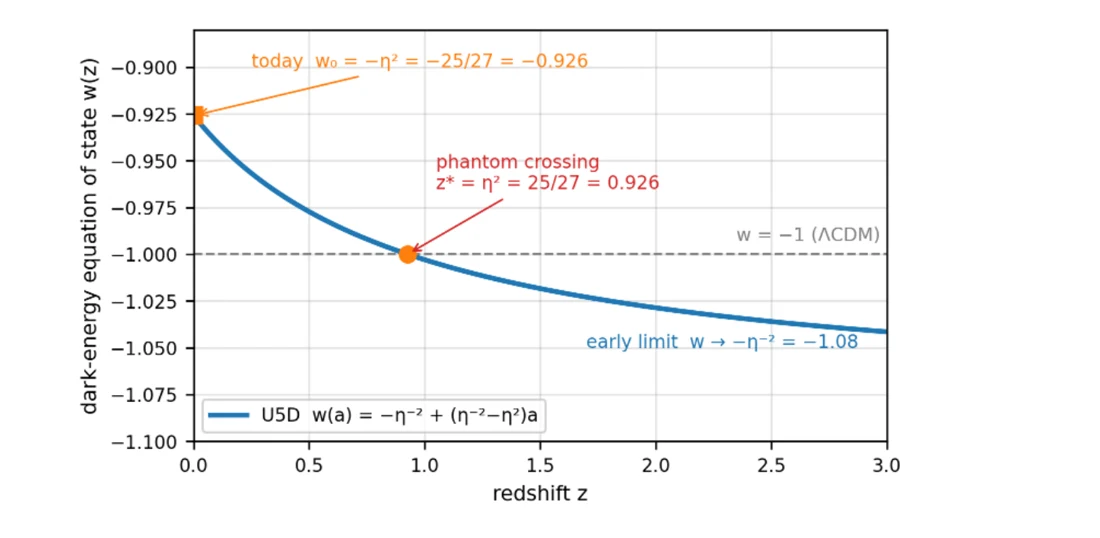
Ω_b = π/64 is the product of the ratio of the active pixel's 4-ball volume to the hypercube volume (π²/32) and the ratio of the radius to the circumference (1/2π). w₀ = −η² arises from the dark-energy pressure seeing the rank-2 (area) projection of η; it is not an independent CPL parameter. The single dynamical assumption is that the pixel's W-void couples to the observable channels through the θ_U-projection: the lensing-slip (rank-1) channel sees the void as (1−η), while the pressure (rank-2) channel sees it as (1−η²). Σ(0) = η and 1+w₀ = 1−η² are the two outputs of this single projection postulate and cannot be tuned independently. The algebraic consequence (1+w₀)/(1−Σ(0)) = (1−η²)/(1−η) = 1+η = 1.962 is a parameter-free internal-consistency test.
4. Gravitational slip: the Σ<1 prediction
The void fraction 1−η is a geometric capacity measure. We phenomenologically attribute the resulting gravitational slip to an effective projected bulk-Weyl anisotropic stress and impose the corresponding closure as a boundary-condition ansatz. The lensing potential seen by light and the attraction felt by matter then scale differently:
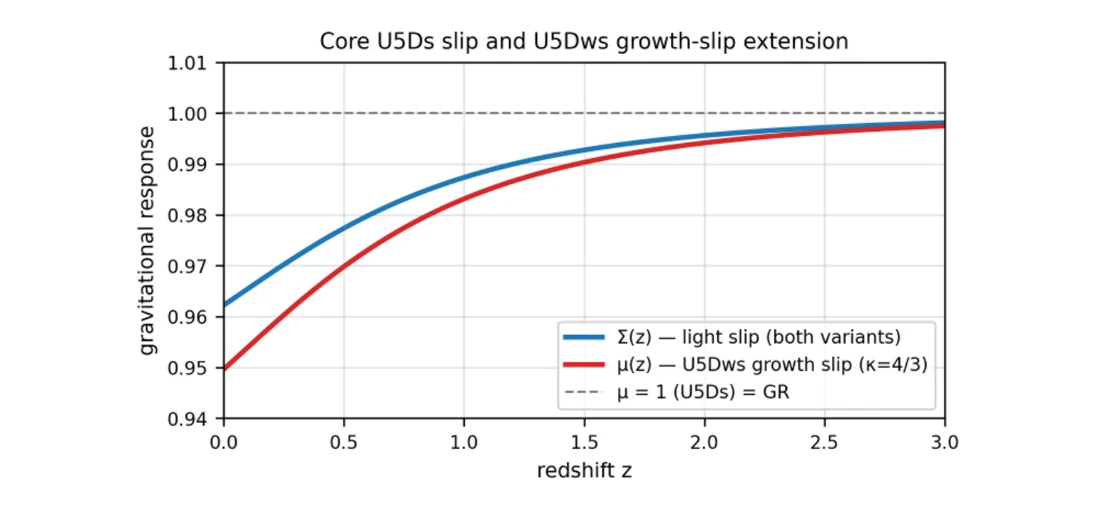
Σ(z) = 1 − A_Σ · L(z) [lensing] ; μ(z) = 1 − κ · A_Σ · L(z) [growth]
Here L(z) = Ω_DE(z)/Ω_DE0 and κ is the growth-slip coefficient. Today Σ(0) = η = 0.962; at high redshift the slip converges to the GR value 1. The minimal model fixes only the light slip and sets κ = 0 (μ = 1, U5Ds). The geometric closure suggests κ = 4/3 (U5Dws), for which μ(0) = 0.950 — but this coefficient is not derived from the theory and is not identified by current data. We restrict the phenomenological sector to luminal tensor propagation (α_T = 0), consistent with GW170817.
5. Substrate geometry
The following are motivational combinatorial facts about the substrate; deriving the cosmological parameters from them is an open problem. Regge angle-deficit: since the dihedral angle of the 16-cell is 120°, the channels tile flat E⁴ with no deficit; since the dihedral angle of the 5-cell is arccos(¼) = 75.52°, the core carries a 57.91° deficit (curvature) at 4×75.52° = 302.09°. W-B-B combinatorics: of the pixel's 8 boundary vertices 6 are spatial (light), 2 are W-directed; every three-dimensional boundary cell contains exactly one W vertex (B-B: 12, B-W: 12, W-W: 0).
6. Data and method
The analysis was carried out with Cobaya. 19 likelihood blocks were combined in a common set: Planck NPIPE CamSpec (high-ℓ), Planck low-ℓ TT/EE and lensing, ACT DR6 lensing, SPT-3G 2022, BICEP/Keck 2018; Pantheon+ supernovae; DESI DR2 and SDSS DR16 BAO; cosmic chronometers; the 63-point fσ8 compilation; KiDS-1000, DES-Y3, HSC-Y3 weak-lensing S8 priors; eROSITA cluster-S8; SH0ES/JWST H₀. Each model was run with the Gelman–Rubin criterion R−1 < 0.05.
The last five (KiDS/DES-Y3/HSC/eROSITA S8 and SH0ES/JWST H₀) are not full likelihoods but compressed (Gaussian) priors on the published, largely ΛCDM-derived S8/H₀ values; used here as a pre-screen, they require a model-consistent cosmic-shear/cluster re-analysis for confirmatory inference (future work). The growth effect of the gravitational slip (μ<1) was applied to the fσ8 observation via a suppression kernel; an independent MGCAMB computation gave the same magnitude (≈2.3% suppression in fσ8). The total constraints draw on ≈160 million galaxies and quasars — dominated by the imaging surveys DES-Y3 (≈100 M), HSC (≈25 M), KiDS (≈21 M) and DESI DR2 (≈14 M) — together with ≈1,550 supernovae, ≈5,300 clusters and all-sky CMB.
7. Results
Same-set model ladder on the full data set:
| Model | k | χ² | Δχ² vs ΛCDM |
|---|---|---|---|
| U5Dws (w(a); Σ<1, μ<1) | 4 | 14884.81 | −13.16 |
| U5Ds (w(a); Σ<1, μ=1) | 4 | 14888.13 | −9.84 |
| w0waCDM (free w₀, w_a) | 8 | 14890.73 | −7.24 |
| U5Dw (w(a); no slip) | 4 | 14893.81 | −4.17 |
| wCDM (free w) | 7 | 14897.22 | −0.75 |
| U5D (constant w=−η; no slip) | 4 | 14897.96 | −0.02 |
| ΛCDM (w=−1; no slip) | 6 | 14897.97 | 0 |
Table 2. Best-fit χ² for all seven models on the same 19-likelihood data set.
ΔBIC = Δχ² + Δk·ln N with N ≈ 1.52×10⁴ effective data points (ln N = 9.63). Because the geometric locks and model variants were developed using overlapping datasets, this comparison is not an out-of-sample confirmation; the prospectively-fixed quantity is the future lensing-slip amplitude, registered with the public archive date.
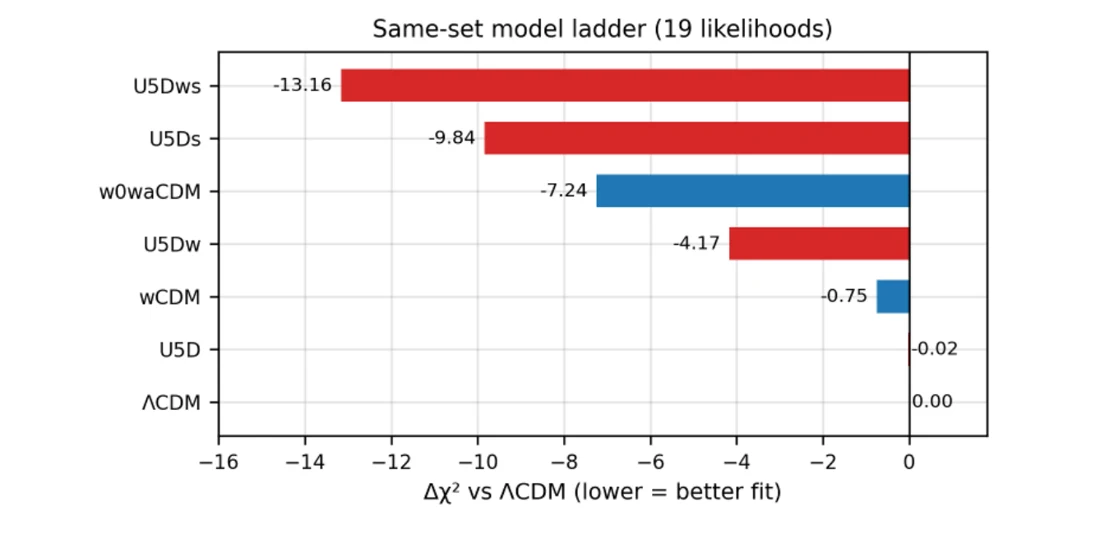
U5Dws gives the best fit with four free parameters (nominal ΔBIC ≈ −32). The source of this preference is the channel decomposition. In the μ = 1 version (U5Ds) most of the advantage comes from the three weak-lensing S8 priors (KiDS, DES, HSC together ≈ −5.0). When μ < 1 is added (U5Dws), most of the extra −3.3 is in the growth channel: the fσ8 contribution drops from 36.0 to 33.8 (−2.2). When fσ8 is removed entirely (18 likelihoods), the dynamical model without slip is practically indistinguishable from ΛCDM (Δχ² ≈ −0.06), independently confirming the gain map. The best fit of U5Dws (−13.16) is therefore an upper-bound variant; the main result is the geometry-motivated Σ(z) < 1 prediction.
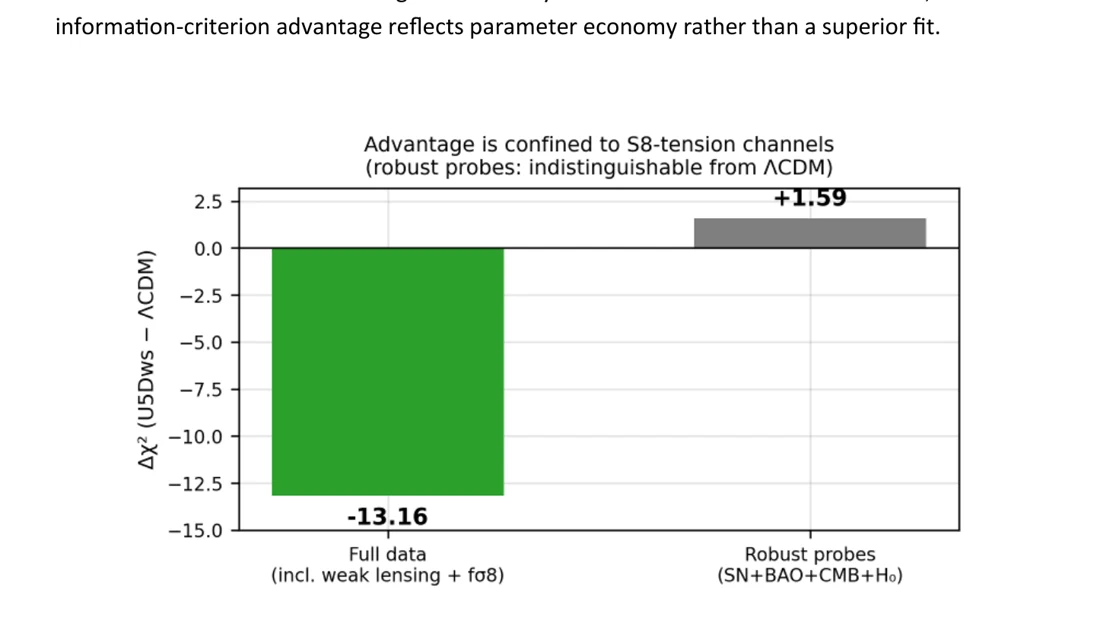
To separate whether the advantage comes from genuine expansion geometry or from the tension-sensitive channel, a run was performed with weak-lensing and fσ8 removed, using only the robust probes — supernovae, BAO, CMB, cosmic chronometers and H₀ (14 likelihoods):
| Model | Δχ² (full, 19) | Δχ² (robust, 14) |
|---|---|---|
| ΛCDM | 0 | 0 |
| U5Ds | −9.84 | +1.7 |
| U5Dws | −13.16 | +1.6 |
Table 3. Full data vs robust probes.
Restricted to the robust set, the U5Dws advantage collapses: relative to a re-optimised ΛCDM on these fourteen likelihoods, U5Dws and U5Ds sit at Δχ² ≈ +1.6 and +1.7 — that is, no preference. U5Dws fits the expansion data better (supernovae −3.8, BAO −1.5), but this is offset by small CMB (+1.2) and local-H₀ (+1.9) penalties; because the geometry is locked, the model cannot re-optimise these channels the way ΛCDM can. The full-data −13.16 therefore originates entirely in the tension-sensitive soft channel, and the information-criterion advantage reflects parameter economy rather than a superior fit.
Posterior means (converged chains, 30% burn-in). For U5Dws the dark-sector fractions are locked, so H₀, τ, n_s, A_s are the only free parameters. The background S8 ≈ 0.80 stays close to ΛCDM: the model matches the low weak-lensing S8 through the slip Σ<1, not a shifted σ8.
| Parameter | ΛCDM | U5Dws |
|---|---|---|
| H₀ [km/s/Mpc] | 68.50 ± 0.22 | 67.66 ± 0.04 |
| Ω_m | 0.298 ± 0.003 | 0.3054 (locked) |
| σ8 | 0.801 ± 0.004 | 0.795 ± 0.003 |
| S8 = σ8√(Ω_m/0.3) | 0.798 ± 0.006 | 0.802 ± 0.004 |
| n_s | 0.9702 ± 0.0024 | 0.9700 ± 0.0019 |
| τ | 0.054 ± 0.005 | 0.058 ± 0.004 |
| ln(10¹⁰ A_s) | 3.042 ± 0.009 | 3.050 ± 0.009 |
Table 4. Posterior means and 68% intervals.
8. Falsifiable prediction and Euclid
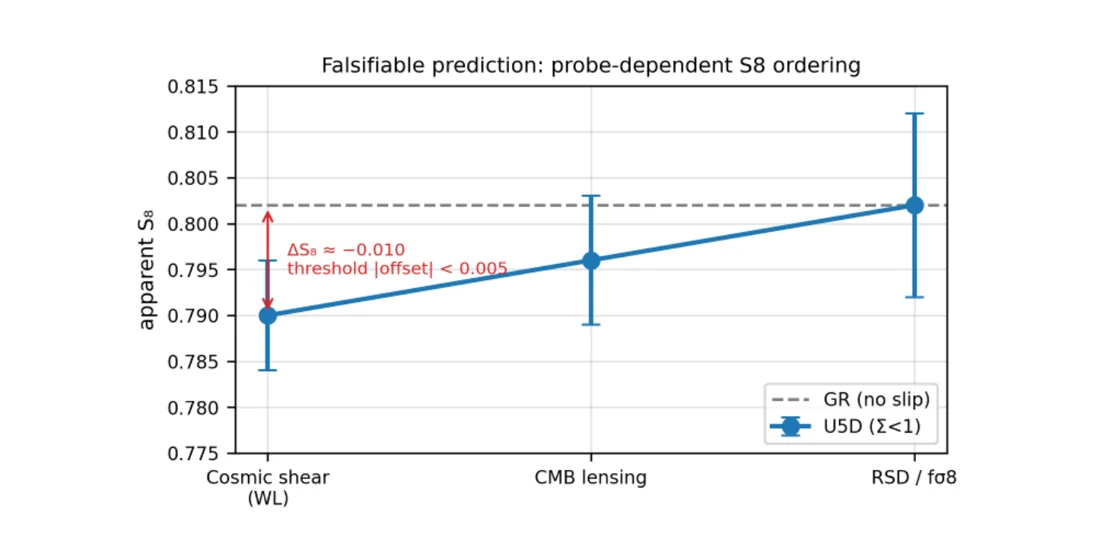
The model's locked, sharp prediction is Σ(z) < 1 (A_Σ = 1−η). The gravitational slip produces a probe-type-dependent S8 ordering: weak-lensing < CMB-lensing < RSD. The present offset is ΔS8 ≈ −0.010; forthcoming tomographic weak-lensing (Euclid plus SO/Advanced-SO CMB-lensing combinations) can test this at the ~1.5–2σ level. The pre-registered falsification threshold is |offset| < 0.005; equivalently, the model is falsified if a tomographic measurement constrains the slip amplitude to A_Σ = 0 (GR), excluding A_Σ = 1−η = 0.0377 at high credibility.
| Model | Free DE par. | w(a) | Σ | μ | Distinguishing |
|---|---|---|---|---|---|
| ΛCDM | 0 | −1 | 1 | 1 | baseline |
| Quintessence | 1+ | > −1 | 1 | 1 | no slip |
| Horndeski | functions | free | varies | varies | free functions |
| DGP / nDGP | 1 | ≈ −1 | ≈1 | >1 | μ>1 (opposite sign) |
| U5D | 0 | η-locked | <1 | 1→<1 | η-lock; Σ<1 (& μ<1) |
Table 5. Position of U5D among modified-gravity families.
9. Limitations and open problems
(1) η = 5/√27 is not derived from a fundamental action; it is a construction resting on two structural axioms and is a particular choice of norm-ratio. (2) A_Σ = 1−η is a postulate. (3) The fit-preference on the full data set comes from a channel degenerate with baryonic feedback; on the robust probes the model is indistinguishable from ΛCDM. (4) The model does not resolve the H₀ tension. (5) The full Friedmann bridge for Ω_cb = 3/π² is open. (6) The w_a component is a phenomenological residual. (7) μ and Σ describe only linear cosmological scales; solar-system and PPN consistency remains an open requirement. (8) The (μ<1, Σ<1) phenomenology is not a novel region; U5D's distinctiveness is locking the whole dark sector to a single geometric constant (η).
10. Conclusion
U5D is a cosmological model with zero free dark-energy parameters that locks the dark sector to a single geometric constant. Its main result is a geometry-motivated falsifiable prediction: a light slip Σ(z) < 1 (A_Σ = 1−η), to be sharply tested by Euclid. On the fit side, the minimal slip model (U5Ds) gives Δχ² = −9.84 and the version adding a growth slip (U5Dws) −13.16 relative to ΛCDM; but this preference is entirely in the S8-tension-sensitive, baryon-degenerate channel, and on the robust probes the model is indistinguishable from ΛCDM. The value of the model lies in two points: the parameter economy of locking the entire dark sector to a single number, and a locked Σ(z) < 1 prediction that can be sharply tested by Euclid. The first-principles derivation of η and Euclid's measurement will determine the model's future.